
In development · Dec 2025 – Present
Latest from this projectBackups and activity log on branchesA web app where photographers share album designs and clients approve spreads and order the options the photographer sells, on a page branded as the photographer's. I ran Claude Code and Codex as the engineering team: a written brief for every task, failing tests first, and a reviewer separate from the builder. Client photographs never reach a model.
The problem
The photographer I built this for sold albums by email. Designs came out of one tool, approval happened in a thread, invoices went out from another tool, and every order went to the lab by hand. The hard part was the selling: the back-and-forth over covers, sizes, quantities and price.
I built a WordPress plugin for this first, Easy Album Orders, in December 2025. In November 2026 I made the album app Rise Plugins’ top priority and rebuilt it as a standalone web app: first so one working photographer can sell albums with very little admin, then as a paid product.
What I built
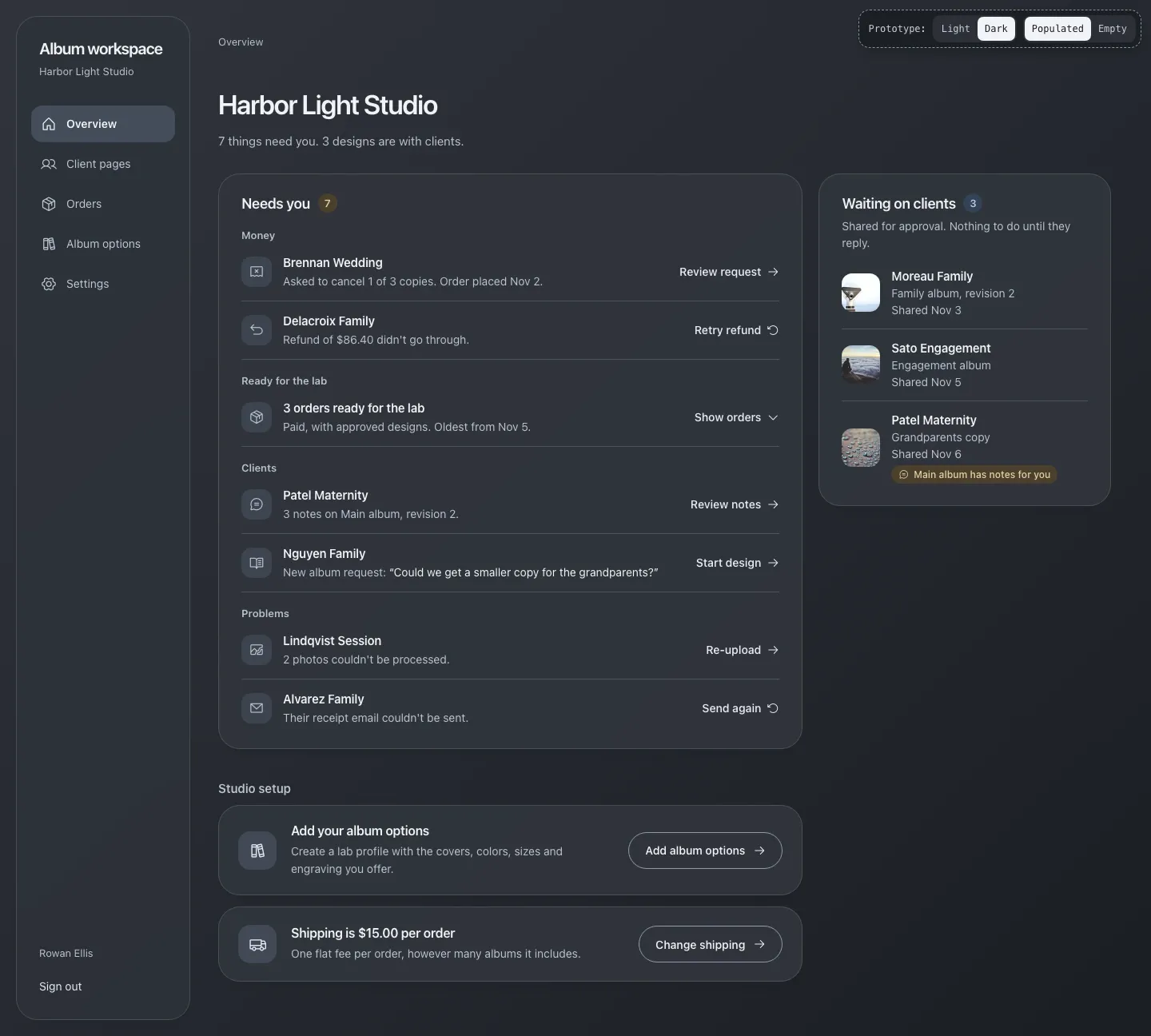
A photographer signs up, enters the album options they actually sell (covers, colors, sizes, engraving, one catalog per lab profile) and uploads spreads designed elsewhere. Each client gets a private, photographer-branded page. Clients leave notes on a spread, approve each design separately, and order several approved designs in one guided checkout, with included copies and dollar credit applied automatically. The photographer approves every cancellation and refund, downloads the exact approved originals for each order and sends them to the lab.
It runs on Cloudflare: Astro and React on Workers, D1 for records, private R2 for photographs, and a Node and Sharp renderer in a Cloudflare Container that turns uploads into previews.
How I built it with AI
I managed. Agents built. Claude Code and Codex worked as one team in separate git worktrees, coordinated through a shared Obsidian vault: one card per workstream, an ownership block, and a resume point written before every session closes. Both tools start from the same project rules and shared memory, so either can pick up the other’s work.
Every task ran on the same contract. The orchestrating session wrote a cold-start brief with binding constraints and a hard boundary: the implementer could not commit, install packages, spawn agents or deploy. Tests came first and had to fail for the right reason. On the media task, 11 renderer tests and 28 API tests failed before any implementation existed. Then the orchestrator re-ran the suites itself, an independent reviewer attacked the work, each fix was shown failing against the old code, and the fix range was reviewed again.
That review found real defects. On the media task, the reviewer proved that an upload timeout would permanently disable “Retry upload”. The orchestrator’s own browser pass caught a sticky footer covering a focused search field at phone width, a bug the automated visibility checks had passed. After the fixes the suite ran 144 of 144.
Staging found one no local test could. My first sign-up there hit a 500: a work-queue query nested deeper than D1 allows, while local SQLite accepted it and 1,044 tests stayed green. The fix added a deploy gate that compiles those queries against the real database before upload.
For larger work I scaled review with multi-agent workflows. Before building the activity log, 23 agents mapped every server-side write in the app, each map checked by a verifier. Then 58 agents attacked the plan through five lenses (database, privacy and abuse, completeness, feasibility, simplicity), with a refuter on every serious finding. None of the 42 blocker or major findings was refuted. A second check of 26 agents, including SQL probes against a draft migration, tested the revision before the build started. I switched that session to Fable because, as I put it then, “this is important work.”
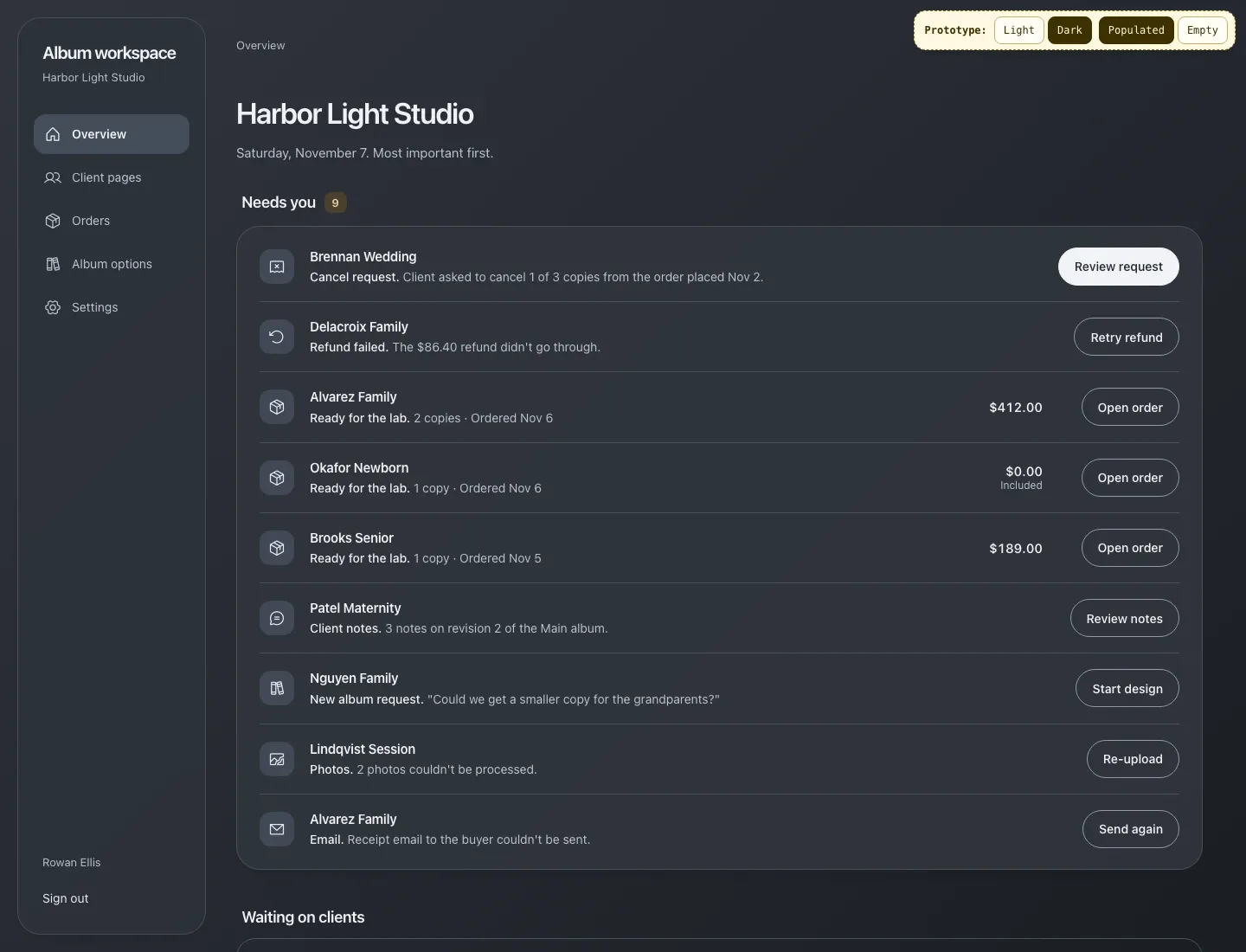
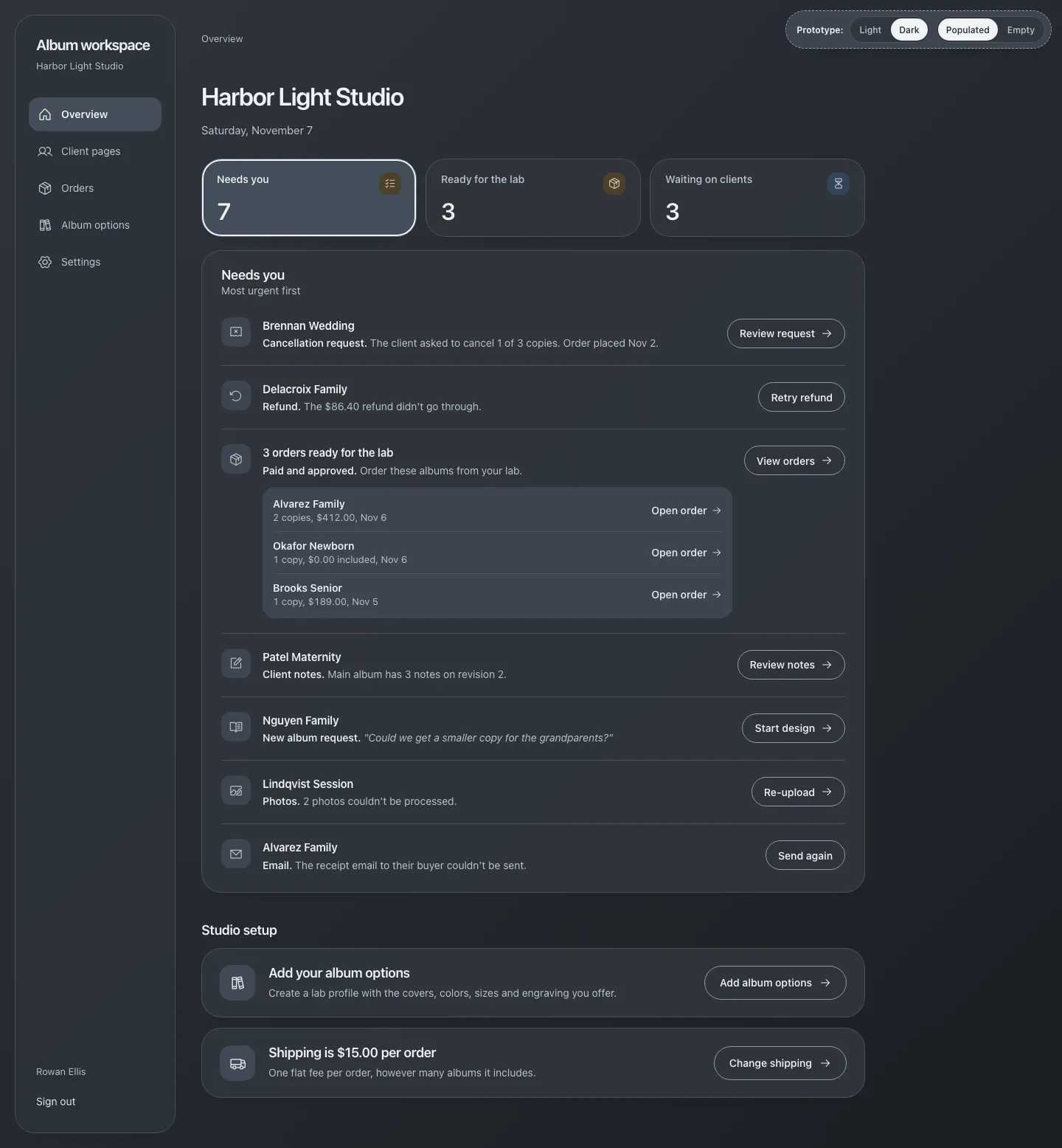
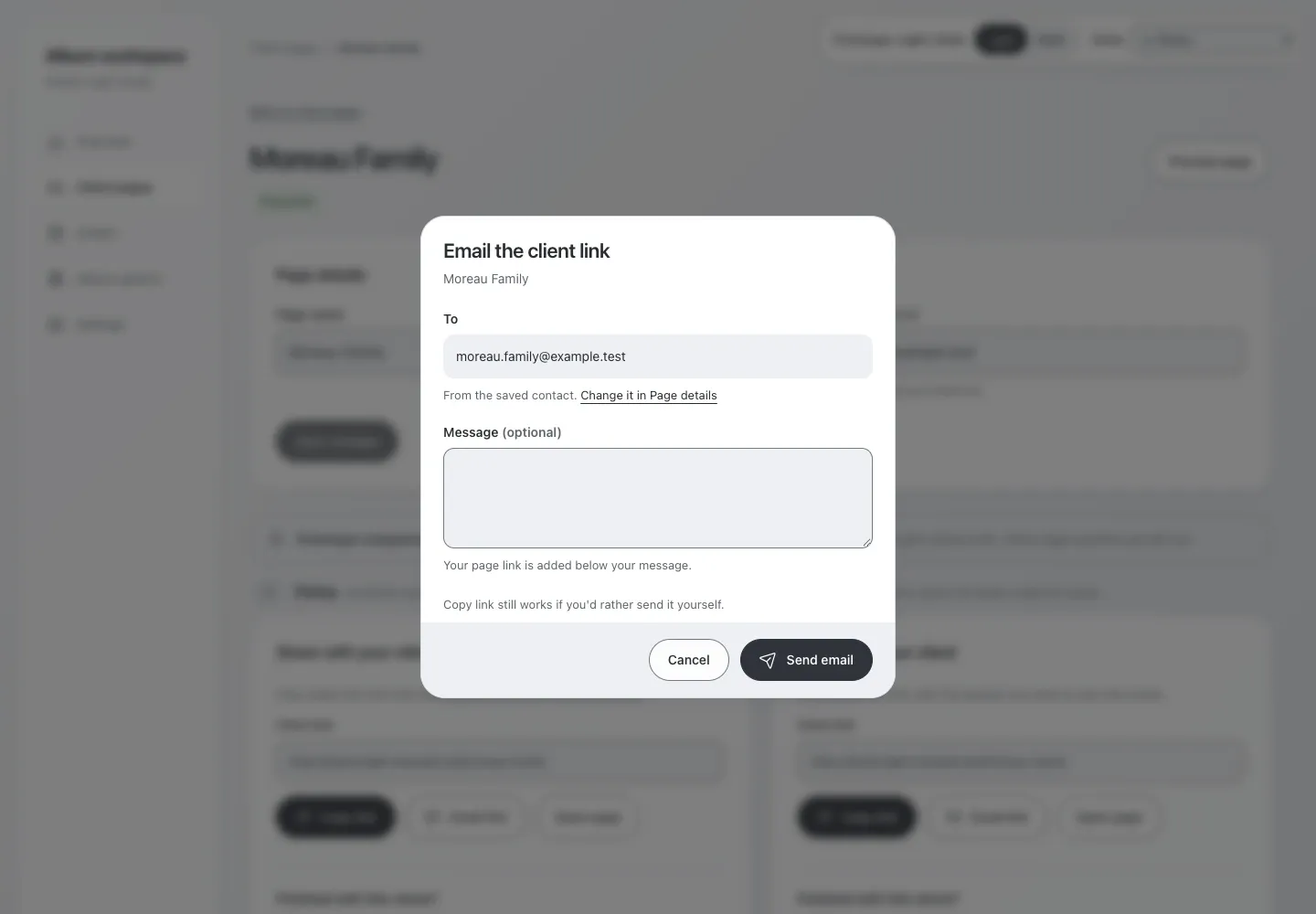
Design used the same split. Agents built two or three working prototypes of the major screens on synthetic data, in light and dark, at desktop and phone widths. I picked the guided checkout, the focused order page, the two-lane overview and the share dialog. The rest stay in the repo for comparison.
Where AI stayed out
Client photographs never reach a model. The rule is written into the build briefs and the README. The renderer is deterministic Sharp code in a container with internet access turned off. Client pages are marked noindex, and known AI crawlers get a 403.
Agents never touched the outside world without my explicit go: no real email, no payment, no deploy. Payments were proven only in Stripe’s sandbox, in a rehearsal I approved. Only synthetic data goes into Git or tests.
The product rules stayed mine. Cancellations and refunds need the photographer’s approval. Design approval alone never places an order. Print readiness is the photographer’s recorded confirmation, not an automated check. Agents ran six rounds of name candidates; I paused naming without picking one, so the app still has no public name.
I also cut AI tooling that got in the way. A second design skill kept flagging the app’s colors against another product’s design file, so I had it removed, hooks and all. One design authority is easier for agents to follow than two that disagree.
Where it is now
Eleven of twelve planned slices are merged. The twelfth, hosting and release, is underway: staging runs real sign-up email and the hosted photo renderer. It is not in production. Checkout is not on staging yet, and there are no live payments and no paying users. Backup and restore code is complete on branches, waiting on a storage account and my merge.
The activity log is where AI comes back in, on my terms. It records what photographers and clients do as typed events with no free text, so Claude can answer “what has this studio done since Tuesday?” with a read-only query. In my experience a lot of support issues are simple user error, like uploading a ZIP instead of a spread PDF. The log is how I see that. The v1 privacy notice, drafted by agents from facts in the code, names Anthropic, says what Claude sees and that a person reads its answer. Its legal blanks stay bracketed until I fill them.
- 157commits to the app in eight days, Nov 5–12
- 911automated tests passing at the work-queue merge
- 1–4 sphoto preview on staging, down from 22–58 s
A project, over time.
The milestones that shaped it, in order.
Easy Album Orders, the WordPress plugin
I started the first version as a WordPress plugin, built with Cursor and a standards file for the AI written on day one.
Plugin 1.0 released
Versions 1.0.0 to 1.0.2 shipped the same day: per-client order forms, configurable materials, sizes and engraving, and album credits.
Rebuild becomes the top priority
Discovery, a 12-slice build plan, and the light and dark appearance I picked from agent-built prototype variants.
Foundation through payments in one day
Accounts, catalogs, private client pages, uploads and design review, then quotes and a sandbox payment lifecycle, all committed on Nov 5.
Checkout, fulfillment and refunds integrated
Guided checkout merged Nov 6; exact original downloads and photographer-approved refunds followed on Nov 7. Proven against Stripe's sandbox only.
Work queue merged, first staging deploy
The two-lane overview and share-by-email merged into the integration branch, and the app went up on an isolated staging environment.
Hosted photo renderer and fast previews
Sharp moved into a Cloudflare Container. My first real upload felt a little slow, so rendering now starts at upload: 1–4 s, down from 22–58 s.
Backups and activity log on branches
Backup and restore code is complete on two unmerged branches, waiting on a storage account. The activity log is being built slice by slice.