
Tonic Site Shop
Tonic Site Shop Helper
The custom plugin a multi-million-dollar template store runs on.
The story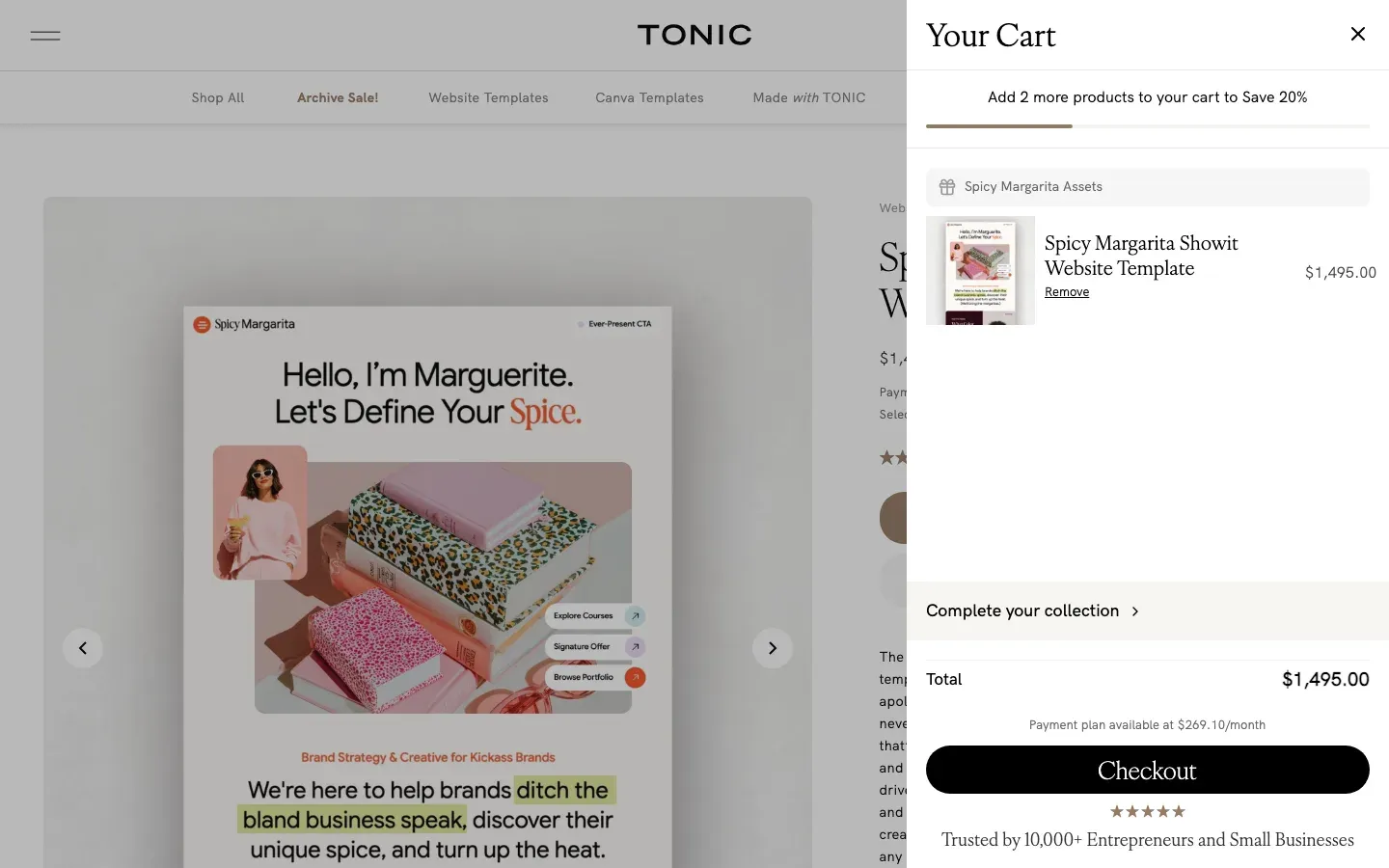
Live · Jan 2026 – Present
Latest from this project1.11.29 liveOne version-controlled WordPress plugin that holds Tonic Site Shop's custom layer: checkout, cart drawer, accounts, affiliates, collections and conversion tracking. I build and maintain it with Claude Code and Codex working from one shared workspace and vault. Every production change still waits for my go.
The problem
Tonic Site Shop sells Showit website templates and Canva templates to entrepreneurs and small businesses. It is a multi-million-dollar WooCommerce store. At the start of 2026 most of its custom behavior lived in a code-snippets plugin, entries edited inside wp-admin, alongside third-party plugins and an n8n instance that wired orders to email and Slack. None of it had version history, and I was the only developer.
What I built
The Tonic Site Shop Helper is one WordPress plugin that holds the store’s custom layer. It started on January 19, 2026 as a straight migration of those snippets into git and grew into the code the shop runs on.
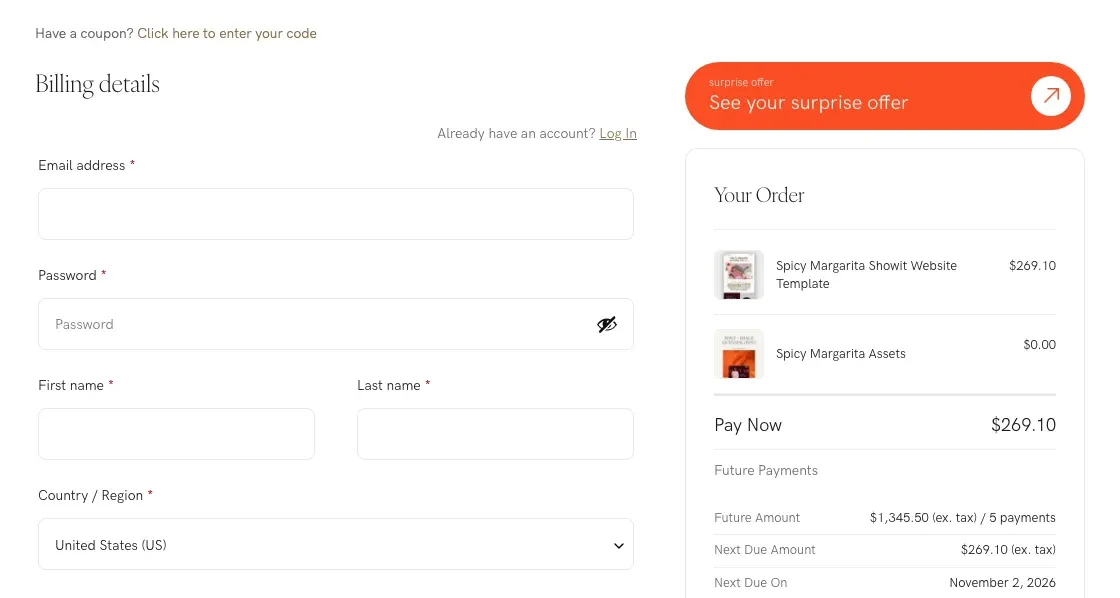
- Checkout and cart. A classic checkout with an order summary sidebar, email as the first field so abandoned carts can be recovered, and payment-plan schedules inline instead of in a modal. The cart drawer shows bundle progress, the collection’s free assets gift, a “complete your collection” row and the plan’s monthly quote.
- Collections and discounts. BundleUp, “three collection pieces, 20% off”, is a virtual coupon defined in code. Beside it sits the coupon rule: one discount code at a time, store credit allowed alongside.
- Accounts. Card-based order history, a products page that hands out Showit share keys and Canva downloads, one account details page, early payoff for payment plans, and a self-serve “add a card” flow that restarts stalled plans.
- Affiliates. An affiliate dashboard and registration, commission on every installment of a payment plan (the commission plugin only saw the first payment), and bulk sale-rate controls for the team.
- Tracking and automation. The full plan value reported at purchase, a hashed email at checkout for ad-platform match quality, and guards that keep test orders out of the numbers. Order automations moved in from n8n. Checkout marketing consent replaced a vendor plugin and now writes contact details only for buyers who opted in.
Sales follow a rule I set in June. Anything that runs indefinitely lives in the helper. Anything tied to one campaign lives in a disposable launch plugin that hooks into the helper’s filters. Activating it is the switch.
How I built it with AI
324 of the repo’s 455 commits carry a Claude Code co-author line, starting February 4, the day the plugin got its CLAUDE.md. The Tonic workspace has a root file that routes each session to the right subproject and to the right pages of an Obsidian vault: a page per snippet, system and project, a daily log, and a plugin changelog that records what shipped, why, and how it was verified. Each finished task is logged as it lands, so the next session starts from the record, not from my memory.
Since November 2, Codex works on the same footing. A startup hook gives it the same root instructions, shared memory and workflow commands, and the vault is the handoff, so either tool can continue where the other stopped. Before that I used Codex as a builder under Claude’s management. For a sales page style switcher prototype in September, Claude wrote the spec, Codex wrote the code, and Claude reviewed it, deployed it to dev and checked it in headless Chrome at phone and desktop widths. That check caught two bugs Codex had no browser to see: the site’s unused-CSS optimizer delaying a brand-new stylesheet, and a phone slider centering on the wrong card because the layout settled after the script ran.
For risky changes the loop is:
- Prove the mechanism read-only against production before writing code.
- Build on a dev clone of the store.
- Run a multi-agent review: finders, then skeptics who try to refute each finding. The n8n port went through two passes, of 24 and 30 agents, before it shipped.
- Show me the change on dev.
- Ship file by file, with a backup and checksums proving production matches the repo, then record it in the vault.
Where AI stayed out
- The production go is mine. Agents stage, dry-run and verify. Nothing reaches the live store until I say “push to prod”. Reviewing dev and answering questions is not the go.
- I look at customer-facing changes myself. A green harness is not a demo. Fourteen automated cases passed for installment commissions, and my first click in wp-admin failed, because the order screen runs save handlers the tests never touched. Any feature that reacts to an order status now gets a real click-through before it is called tested.
- I run the test payments. Agents prepare and guard the scripts. I place the charge.
- Money moves one at a time. A dry run can hide side effects that only a live charge shows, so operations that move money run singly, each confirmed by me with the target named, and scale to small batches only once the pattern is proven.
- Business rules are human calls. Which rate an installment commission pays, whether to back-pay or fix forward, what the team can edit: I decide, or the CEO does. When an agent proposed a new admin field for legacy share keys, I kept them hard-coded in git. Fewer editable things is cleaner.
- A delegated Codex doesn’t ship. When Claude drives it, Codex writes code and nothing else: no commits, no deploys, no record. Claude verifies in a browser before calling the work done.
Where it is now
Version 1.11.29 went live on November 16, 2026, ahead of Black Friday. The repo holds 114 PHP files in eleven folders behind one loader, and 96 vault pages document the snippets. n8n is gone, the vendor consent plugin is gone, and the store’s custom behavior has a commit history and a changelog that says why each release shipped. Production deploys are deliberate copies that I approve.
- 455commits since January 2026
- 324commits with a Claude Code co-author line
- 114snippet files in eleven folders, one loader
A project, over time.
The milestones that shaped it, in order.
Snippets move into a plugin
First commit: the store's code snippets become files in a version-controlled WordPress plugin with a single loader.
Claude Code joins
The plugin gets its CLAUDE.md. From that day most commits carry a Claude Code co-author line.
Block checkout retired
The custom classic checkout, begun March 30, replaces block checkout, with the payment schedule inline and one design system across cart, checkout and thank-you.
BundleUp rebuilt in-house
The three-piece, 20% collection bundle becomes a code-defined virtual coupon, replacing a third-party auto-apply that had broken.
n8n retired
All three n8n workflows are ported into the plugin, reviewed by two multi-agent passes and cut over the same day.
Codex builds, Claude manages
Codex writes a sales page style switcher prototype from Claude's spec. Claude reviews it, deploys it to dev and catches two bugs in a real browser.
One workspace, two agents
Codex gets the same startup baseline, memory and workflow commands as Claude Code, so either tool can pick up the other's work.
1.11.29 live
The current release goes live on production ahead of the Black Friday sale.